
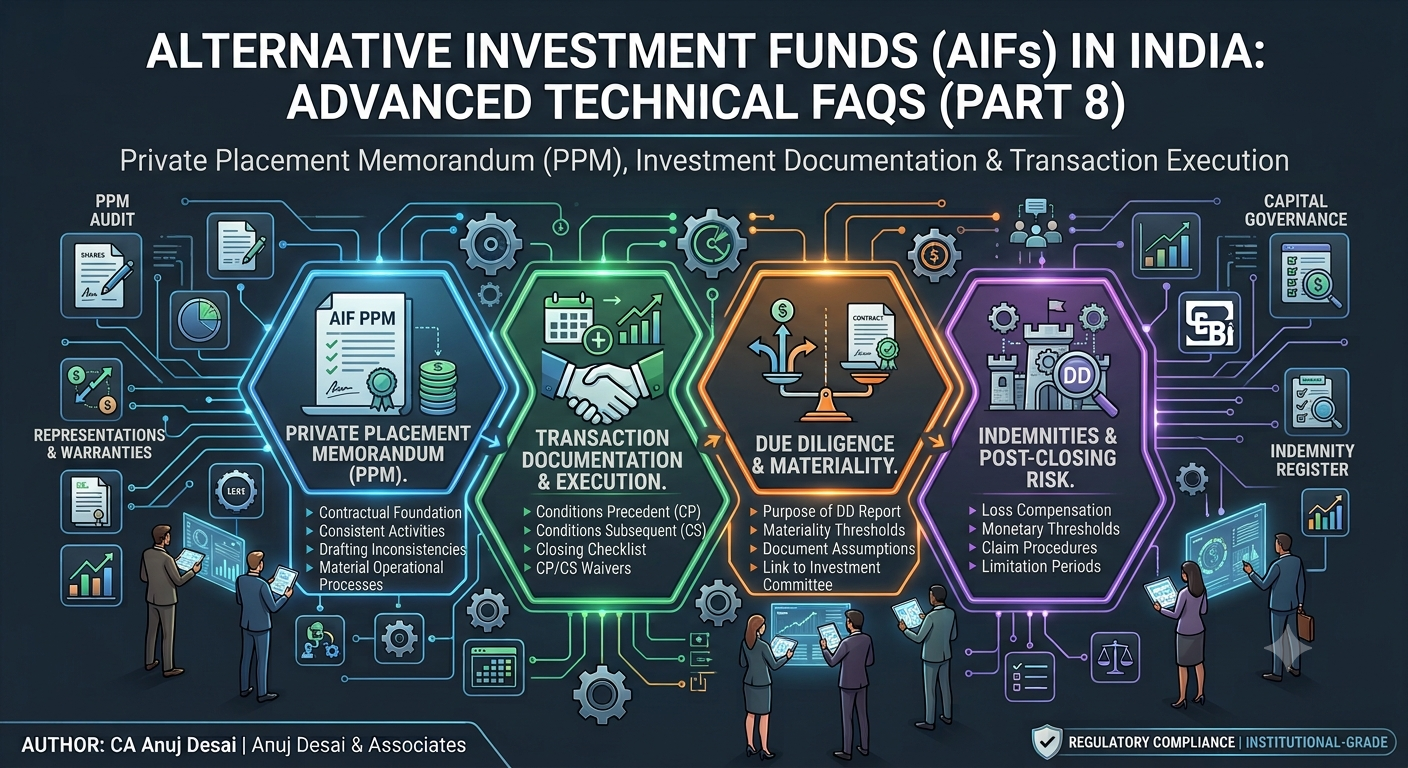
Private Placement Memorandum (PPM)
Why is the Private Placement Memorandum considered the most important legal document of an Alternative Investment Fund?
The Private Placement Memorandum (PPM) forms the contractual and commercial foundation of the Alternative Investment Fund. It communicates the investment strategy, governance framework, risk factors, investor rights, fee arrangements, valuation principles, distribution methodology, conflict management mechanisms and operational policies. Every subsequent operational decision should remain consistent with the disclosures contained in the PPM.
Can an Investment Manager undertake activities that are inconsistent with the PPM?
As a matter of sound governance, Investment Managers should conduct the affairs of the fund consistently with the disclosures made to investors in the PPM. Material deviations without appropriate approvals or disclosures may expose the fund to regulatory scrutiny, contractual disputes and investor grievances.
Why should drafting inconsistencies within the PPM be eliminated before fundraising?
Conflicting provisions relating to investment restrictions, valuation methodology, capital calls, distributions or investor rights may create legal ambiguity and significantly increase the likelihood of future disputes. Comprehensive legal review before launch substantially reduces interpretational uncertainty.
Should the PPM define every material operational process of the Alternative Investment Fund?
Yes. Where commercially appropriate, the PPM should clearly explain the principal operational framework governing investments, capital deployment, distributions, governance, conflicts of interest, investor communications and fund administration. Well-defined processes improve transparency and reduce ambiguity.
Why should cross-references within the PPM be independently verified?
Incorrect clause references frequently create interpretation issues during regulatory inspections, investor negotiations and legal disputes. Comprehensive document validation should therefore form part of every final legal review.
Transaction Documentation
What are Conditions Precedent in an investment transaction?
Conditions Precedent are contractual obligations that must be fulfilled before the investment is completed and funds are released. These commonly include regulatory approvals, execution of definitive agreements, completion of due diligence, board approvals and satisfaction of commercial conditions.
What are Conditions Subsequent?
Conditions Subsequent are obligations that become enforceable after completion of the investment transaction. They may include completion of statutory filings, implementation of governance reforms, execution of ancillary agreements or achievement of specified compliance milestones.
Why should Conditions Precedent be objectively verifiable?
Every Condition Precedent should be capable of independent verification through documentary evidence. Objective drafting minimises interpretational disputes and facilitates efficient transaction closing.
Can an Investment Manager waive Conditions Precedent?
Subject to the governing investment documents and internal approval framework, certain Conditions Precedent may be waived where commercially appropriate. However, waivers should be documented carefully together with the rationale supporting the decision.
Why should closing checklists accompany every investment transaction?
Closing checklists provide structured confirmation that every contractual, regulatory, financial and operational requirement has been satisfied before investment proceeds are released.
Due Diligence Documentation
What is the purpose of a Due Diligence Report?
A Due Diligence Report consolidates legal, financial, commercial, tax, regulatory and operational findings relating to the target company. It enables informed investment decisions by identifying material risks before capital is deployed.
Should due diligence materiality thresholds be defined before commencing the review?
Yes. Clearly defined materiality thresholds enable advisors to distinguish routine observations from issues requiring escalation to the Investment Committee or governing body.
Why should due diligence assumptions be documented?
Every due diligence exercise necessarily relies upon assumptions, management representations and available information. Recording these assumptions improves transparency and facilitates future review if disputes subsequently arise.
Should unresolved due diligence issues remain open after closing?
Where commercially unavoidable, unresolved matters should ordinarily be converted into Conditions Subsequent, indemnities, escrow arrangements or other contractual protections before completion.
Why should due diligence findings be linked to investment approval memoranda?
Integrating due diligence findings into the Investment Committee Memorandum ensures that decision-makers evaluate identified risks alongside valuation assumptions, transaction economics and strategic considerations.
Representations & Warranties
What are Representations and Warranties in an investment agreement?
Representations and Warranties are contractual statements made by the investee company and its promoters regarding matters such as corporate authority, ownership of assets, financial statements, compliance with laws, taxation, intellectual property, litigation and regulatory status.
Why are Representations and Warranties critical for institutional investors?
They allocate legal risk by providing contractual remedies if material statements subsequently prove inaccurate. Robust representations strengthen investor protection and support post-closing enforcement.
Should Representations and Warranties survive closing?
Investment agreements commonly specify survival periods during which claims relating to inaccurate representations may be asserted. Appropriate survival provisions provide clarity regarding post-closing liability.
What is a Material Adverse Change (MAC) clause?
A Material Adverse Change clause permits investors to reconsider or terminate a proposed transaction if significant negative events materially affect the financial position, operations or prospects of the target company before completion.
Why should Material Adverse Change clauses be carefully drafted?
Overly broad MAC clauses create uncertainty, while excessively narrow provisions may fail to protect investors against significant commercial deterioration. Precise drafting improves certainty and enforceability.
Indemnities
What is an indemnity in an investment transaction?
An indemnity is a contractual obligation requiring one party to compensate another for specified losses arising from identified risks, breaches of contract, litigation, taxation issues or regulatory liabilities.
Why are indemnities different from Representations and Warranties?
Representations establish factual statements regarding the business, whereas indemnities allocate financial responsibility for specified losses irrespective of broader contractual remedies.
Should indemnity claims be subject to monetary thresholds?
Commercial investment agreements frequently prescribe thresholds, baskets, caps or deductibles to ensure that indemnity mechanisms operate proportionately while avoiding insignificant claims.
Why should indemnity obligations specify claim procedures?
Detailed claim procedures reduce disputes by clearly defining notification timelines, supporting documentation, defence rights, settlement procedures and payment obligations.
Should indemnity registers be maintained after transaction closing?
Yes. Maintaining a register of indemnity obligations, limitation periods, pending claims and settlement status enables efficient post-investment monitoring and legal risk management.
Need Expert Assistance with Alternative Investment Funds?
Whether you require assistance with Private Placement Memorandum drafting, PPM review, transaction documentation, due diligence, investment agreements, fund structuring, legal documentation, PPM Audit, SEBI compliance, investment execution or institutional governance, Anuj Desai & Associates provides specialised advisory services across the complete lifecycle of Alternative Investment Funds. Our professionals advise Sponsors, Investment Managers, Trustees, Venture Capital Funds, Private Equity Funds, Infrastructure Funds, Family Offices and institutional investors on fund documentation, transaction structuring, regulatory compliance and governance frameworks. Partner with Anuj Desai & Associates to establish legally robust documentation, strengthen transaction execution and build institutional-grade Alternative Investment Funds.
Disclaimer
The information contained in this article is intended solely for educational and informational purposes and should not be construed as legal, tax, regulatory, accounting or investment advice. The applicability of the concepts discussed above depends upon the governing transaction documents, contractual negotiations, applicable law and the SEBI (Alternative Investment Funds) Regulations, 2012, together with subsequent amendments and circulars. Readers should obtain professional advice before acting upon any information contained herein. While reasonable care has been taken in preparing this publication, Anuj Desai & Associates accepts no liability for any loss arising from reliance on its contents.