
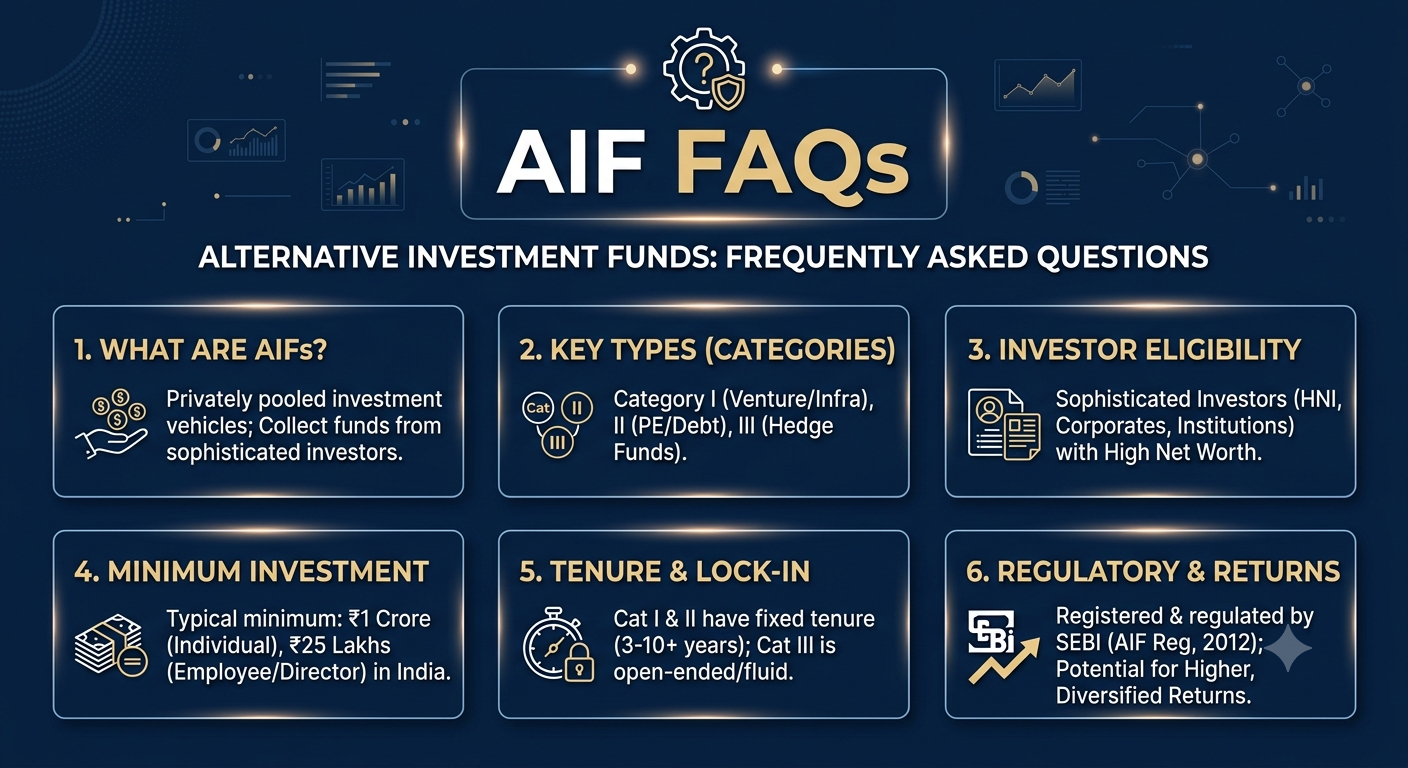
Alternative Investment Funds are one of the most misunderstood — and most consequential — structures in Indian private capital. Below, we've answered the questions we get asked most often by fund managers, sponsors, investors, and founders navigating AIFs in India.
## The Basics
What is an Alternative Investment Fund (AIF)?
An AIF is a privately pooled investment vehicle — established as a trust, company, LLP, or body corporate — that collects funds from sophisticated investors (Indian or foreign) to invest according to a defined investment policy, and is registered with SEBI under the SEBI (Alternative Investment Funds) Regulations, 2012. It sits outside the regulatory frameworks that govern mutual funds, collective investment schemes, or insurance.
Who regulates AIFs in India?
The Securities and Exchange Board of India (SEBI), under the AIF Regulations, 2012. AIFs set up in International Financial Services Centres (like GIFT City) are instead regulated by the International Financial Services Centres Authority (IFSCA) under its Fund Management Regulations, 2022.
What are the three categories of AIFs?
-
Category I AIF — funds investing in start-ups, early-stage ventures, SMEs, social ventures, or infrastructure, considered to have positive spillover effects on the economy. Includes Venture Capital Funds, SME Funds, Social Venture Funds, and Infrastructure Funds.
-
Category II AIF — funds that don't fall under Category I or III and don't undertake leverage other than to meet day-to-day operational requirements. Includes most private equity funds, debt funds, and real estate funds.
-
Category III AIF — funds that employ diverse or complex trading strategies, including leverage through investment in listed or unlisted derivatives. Includes hedge funds.
What's the difference between an AIF and a Venture Capital Fund (VCF)?
Older VCFs registered under the SEBI (Venture Capital Funds) Regulations, 1996 continue to be governed by that framework until they wind up, unless they choose to migrate. Since 2012, all new venture-style funds register as Category I AIFs. A Category I AIF (Venture Capital sub-category) and an old-regime VCF are functionally similar but sit under different regulations.
Can an AIF invest in both listed and unlisted securities?
It depends on the category and the fund's own investment strategy as stated in its Private Placement Memorandum (PPM). Category I and II AIFs are generally oriented toward unlisted investments, though some flexibility exists; Category III AIFs actively trade listed securities and derivatives.
## Setting Up an AIF
What's the minimum corpus required to launch an AIF?
SEBI regulations prescribe a minimum fund corpus, and a minimum investment amount per investor, which have been revised over time — it's essential to check the current thresholds under the AIF Regulations before finalising a PPM, since these figures are periodically updated by SEBI.
Who can invest in an AIF?
AIFs are meant for sophisticated investors — typically high-net-worth individuals, family offices, institutions, and corporates — not retail investors. There's a minimum investment threshold per investor (subject to limited exceptions for fund managers, employees, and directors).
What is a Private Placement Memorandum (PPM), and why does it matter so much?
The PPM is the foundational legal and commercial document of an AIF — it sets out the fund's investment strategy, structure, fee terms, drawdown mechanics, governance, and investor rights. Every operational detail of the fund — including subsequent closings, catch-up contributions, and NAV-based unit allotment — is governed by what the PPM says. Ambiguity in a PPM almost always surfaces later as a dispute or a compliance gap.
What is a "Subsequent Closing," and how does it affect existing investors?
Most closed-ended AIFs raise capital in tranches — an initial closing, followed by one or more subsequent closings. Investors admitted at a subsequent closing are typically required to make a "catch-up contribution" and often an "imputed cost" or "equalisation" payment, so that all investors are placed on an equal footing regardless of when they entered. The precise mechanics (NAV credit, unit allotment, day-count basis) must be defined clearly in the PPM to avoid disputes.
Do AIFs need a separate custodian?
Yes — AIFs with a corpus above a specified threshold (and Category III AIFs regardless of corpus) are required to appoint a SEBI-registered custodian.
Can an AIF invest in Compulsorily Convertible Debentures (CCDs) or Compulsorily Convertible Preference Shares (CCPS)?
Generally yes, subject to what the fund's registration category permits and what its PPM authorises. For Category I VCFs specifically, this needs to be checked against both SEBI's definition of permitted investments under Regulation 2(1)(j) of the AIF Regulations and the fund's own PPM terms.
## Compliance & Reporting
What ongoing reporting does an AIF need to do with SEBI?
Historically, AIFs filed a quarterly activity report with SEBI (via the IVCA-hosted format) within 15 days of quarter-end. This has changed as of a SEBI circular dated March 4, 2026 — AIFs now file a comprehensive Annual Activity Report (within 30 days of financial year-end, first due 31 May 2026 for FY 2025-26) plus a lighter Quarterly Activity Report for the June, September, and December quarters only.
Where do AIFs file their reports now?
Both the Annual Activity Report and the Limited Quarterly Activity Report are filed online through the SEBI Intermediary (SI) Portal — not just the IVCA website as before.
What happens if an AIF misses a filing deadline?
Non-compliance with reporting obligations under the AIF Regulations can attract regulatory action from SEBI, including penalties. Beyond the direct consequence, missed filings are often what trigger a broader SEBI inspection of the fund's other compliance areas.
Does an AIF need a compliance officer?
AIFs are expected to have robust internal compliance mechanisms, and larger/complex funds typically designate a dedicated compliance officer to track SEBI, FEMA, and Income Tax obligations across the fund's life cycle.
What is the Standards Forum / IVCA's role in AIF compliance?
The Indian Venture and Alternate Capital Association (IVCA) functions as the industry's Standards Forum, in consultation with SEBI. It hosts reporting formats, helps standardise industry practices, and assists AIFs in understanding new reporting requirements when SEBI issues fresh circulars.
Are AIFs required to get their accounts audited?
Yes. AIFs must have their financial statements/accounts audited annually, in addition to their regulatory reporting obligations.
Taxation of AIFs
How are Category I and Category II AIFs taxed?
Category I and Category II AIFs enjoy "pass-through" tax status under the Income-tax Act. This means income earned by the fund (other than business income) is not taxed at the fund level — it's taxed directly in the hands of investors, in the same character (capital gains, interest, dividend, etc.) as it would have been had the investor earned it directly. The fund itself pays tax only on business income, generally at the maximum marginal rate.
Is Category III AIF taxation different?
Yes — Category III AIFs do not get pass-through status. Income at the fund level is taxed in the hands of the fund itself (as an AOP, company, or firm depending on structure), typically at the maximum marginal rate, rather than being passed through to investors.
What happens to losses at the AIF level — can investors use them?
Under the pass-through regime, business losses of a Category I/II AIF are carried forward and set off at the fund level itself, not passed through to investors. Non-business losses can, subject to specific conditions (including a minimum unit-holding period), be passed through to and used by investors.
Does an AIF need to issue any tax statement to investors?
Yes — the fund (or the person responsible for making payments on its behalf) must furnish a prescribed statement to each investor and to the tax authorities, detailing the nature and quantum of income paid or credited during the year, so investors can correctly report pass-through income in their own returns.
Are foreign investors in an AIF taxed differently?
Foreign investors are taxed based on the nature of income passed through to them and applicable Double Taxation Avoidance Agreement (DTAA) provisions, subject to compliance with FEMA and any withholding tax obligations of the fund.
## FEMA & Cross-Border Aspects
Can a foreign investor invest in an Indian AIF?
Yes, subject to FEMA regulations — typically through the Foreign Venture Capital Investor (FVCI) route, the Foreign Portfolio Investor (FPI) route (for Category III AIFs investing in listed instruments), or as a non-resident investor under applicable FEMA rules, depending on the fund's category and strategy.
Can an Indian AIF invest outside India?
Yes, subject to conditions under FEMA's overseas investment framework (including the Foreign Exchange Management (Overseas Investment) Rules, 2022), and within limits/approvals applicable to AIFs specifically.
Do AIFs set up in GIFT City / IFSC follow the same rules as domestic AIFs?
No — AIFs set up in an IFSC are regulated by the IFSCA under a separate framework (IFSCA Fund Management Regulations, 2022), with different registration, reporting, and tax considerations, including certain benefits designed to attract global fund managers to set up in India's IFSC.
## Winding Up & Exit
How does an AIF wind up?
Closed-ended AIFs typically wind up at the end of their defined tenure (subject to permitted extensions under the PPM and SEBI regulations), or earlier if specific trigger events occur. The process involves distribution of remaining assets/proceeds to investors, final regulatory filings, and formal deregistration with SEBI.
Can an AIF's tenure be extended?
Yes, subject to conditions laid down in the AIF Regulations and what the PPM permits — typically requiring investor consent above a specified threshold.
What happens to unclaimed/undistributed amounts on winding up?
These are governed by specific SEBI norms on winding-up procedures, which prescribe how remaining amounts should be handled, including timelines for final distribution to investors.
Working With Us
What does Anuj Desai & Associates do for AIFs?
We work with fund sponsors, managers, and investors across the AIF life cycle — PPM interpretation and structuring input, SEBI/FEMA/Income Tax compliance calendars, financial modelling for closing mechanics (catch-up contributions, equalisation, NAV-based unit allotment), and ongoing regulatory reporting support.
I'm setting up a new AIF — where should I start?
Get in touch before your PPM is finalised, not after. Structuring decisions made at the PPM stage — categorisation, closing mechanics, fee structure, tax positioning — are expensive to unwind later. We can review draft PPMs, model out closing scenarios, and build your fund's compliance calendar from day one.
This FAQ is for general informational purposes only and does not constitute legal, tax, or investment advice. Rules governing AIFs change frequently — please consult us for guidance specific to your fund's category, structure, and circumstances.
— CA Anuj Desai, Anuj Desai & Associates, Chartered Accountants