
SEBI Introduces a New Reporting Framework for Alternative Investment Funds (AIFs)
The Securities and Exchange Board of India (SEBI) has significantly revised the regulatory reporting framework applicable to Alternative Investment Funds (AIFs). The revised framework replaces the earlier quarterly reporting model with a more structured combination of an Annual Activity Report and a Limited Quarterly Activity Report, aimed at reducing compliance costs while improving regulatory oversight. For AIFs, Investment Managers, Trustees, Sponsors, Compliance Officers, Fund Administrators and Auditors, understanding this revised reporting framework is essential to ensure timely compliance and avoid regulatory action.
Background
Under Regulation 28 of the SEBI (Alternative Investment Funds) Regulations, 2012, every registered AIF is required to submit periodic reports regarding its activities. Historically, AIFs submitted detailed Quarterly Activity Reports. Recognising the rapid evolution of the AIF ecosystem and after consultation with the AIF Standards Forum and industry participants, SEBI has introduced a more efficient reporting mechanism.
Why did SEBI change the reporting framework?
The revised reporting system aims to: • Reduce repetitive compliance • Improve quality of regulatory reporting • Standardise reporting formats • Digitise submissions • Improve supervisory oversight • Reduce operational costs for AIFs • Enhance accuracy of regulatory data The revised framework also follows recommendations made by the Working Group on Ease of Doing Business and Reducing Cost of Compliance.
What has changed?
Earlier Framework Every AIF submitted: • Quarterly Activity Report • Within 15 days from every quarter end • Through IVCA reporting platform
Revised Framework
Every AIF must now submit:
1. Annual Activity Report (AAR)
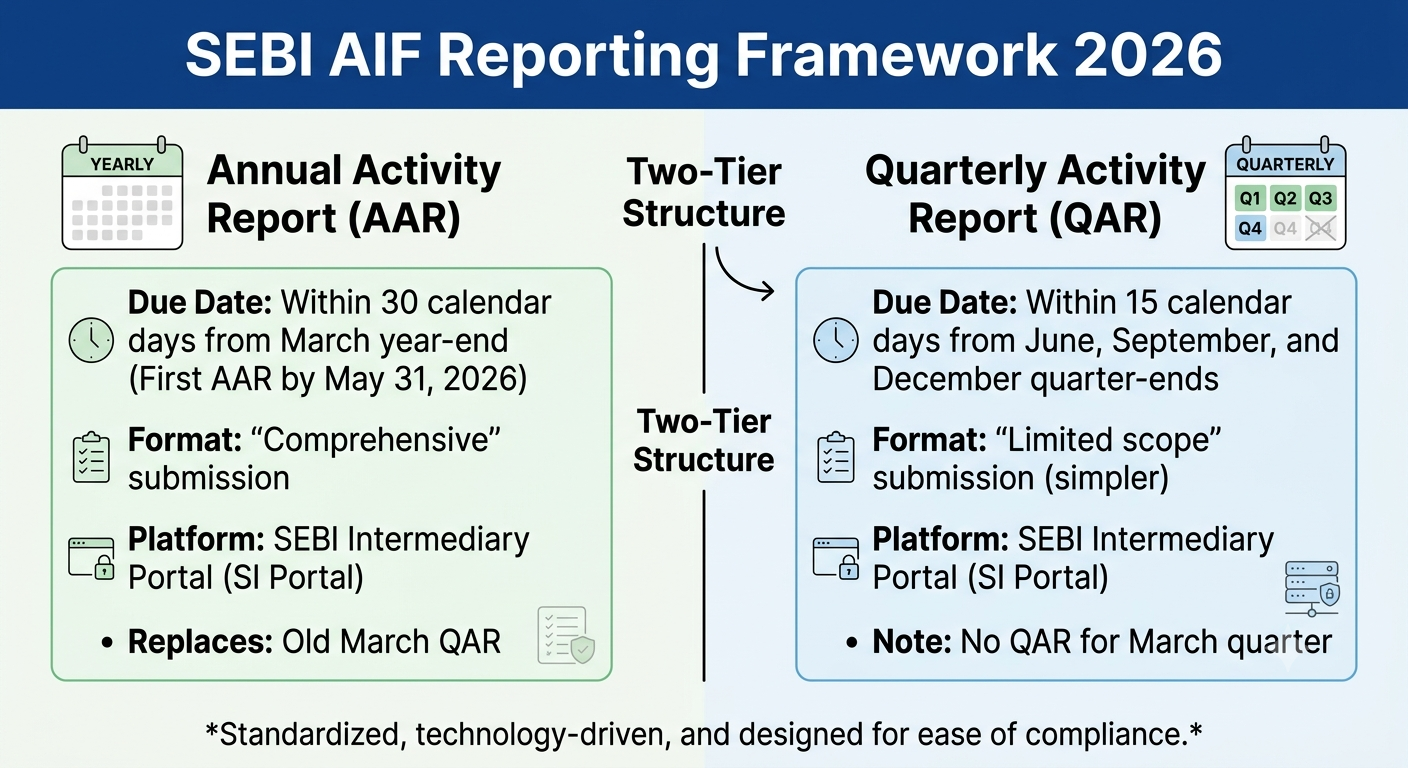
A comprehensive report covering the financial year. Submission Timeline: Within 30 calendar days from the end of March. Example: For FY 2025–26 Due Date: 31 May 2026.
2. Limited Quarterly Activity Report
A simplified quarterly return. Submission Timeline: Within 15 calendar days from quarter end. The first report under the revised framework applies to the quarter ending June 2026.
Important Dates Compliance Due Date Annual Activity Report (FY 2025–26) 31 May 2026 June Quarter Report 15 July 2026 September Quarter 15 October December Quarter 15 January
No Separate March Quarter Reporting
One important change is that no separate Quarterly Activity Report is required for the March quarter, because the Annual Activity Report already captures the required information. This removes duplicate reporting.
Where must reports be filed?
All reports must now be submitted through the: SEBI Intermediary (SI) Portal Earlier reporting through the IVCA reporting mechanism is replaced under the revised framework, although IVCA continues to support implementation and guidance.
Information likely to be reported
While SEBI may revise reporting formats periodically, AIFs should maintain robust records relating to: • Fund corpus • Capital commitments • Drawdowns • Investments • Exits • Investor information • Borrowings • Leverage • Valuation • NAV • Portfolio composition • Category-wise investments • Regulatory breaches • Related party transactions • Overseas investments • Concentration limits • ESG disclosures (where applicable)
Impact on AIF Managers
Investment Managers should review their internal processes to ensure: • Accurate investor data • Updated fund accounting • Reconciled NAV • Capital account reconciliation • Investment schedules • Custodian reconciliation • Auditor coordination • Compliance calendar updates
Role of Compliance Officer
The Compliance Officer should: • Monitor reporting deadlines • Validate information submitted • Coordinate with administrators • Review supporting documents • Maintain audit trail • Ensure SI Portal submissions are complete
Role of Fund Accountants
Fund accounting teams should ensure: • Capital call reconciliation • Drawdown accuracy • Distribution reconciliation • Carried interest computation • Management fee calculations • Investor capital balances • Portfolio valuation • Trial balance finalisation
Consequences of Non-Compliance
Delayed or inaccurate reporting may expose an AIF to: • Regulatory observations • Additional information requests • SEBI inspections • Monetary penalties where applicable • Compliance deficiencies • Increased regulatory scrutiny
Practical Example
Consider a Category II Infrastructure Fund with ₹1,200 crore of commitments. Instead of preparing four detailed quarterly submissions every year, the fund now prepares: • One comprehensive Annual Activity Report • Three limited Quarterly Activity Reports This reduces repetitive reporting while ensuring SEBI receives critical supervisory information throughout the year.
Compliance Checklist
✔ Update compliance calendar ✔ Review reporting formats ✔ Train compliance team ✔ Coordinate with fund administrator ✔ Validate investor database ✔ Reconcile fund accounts ✔ Verify valuation reports ✔ Review NAV ✔ File within timelines ✔ Maintain supporting documentation
Best Practices
Leading fund managers should consider: • Monthly compliance reviews • Automated reporting workflows • Internal reporting calendar • Periodic mock compliance reviews • Independent compliance checks • Maker-checker controls • Documentation of assumptions • Audit-ready working papers
Conclusion
The revised reporting framework reflects SEBI's continued focus on balancing regulatory oversight with ease of doing business. Although the frequency of detailed reporting has reduced, the expectation of accurate, timely and high-quality reporting has increased. Fund managers should therefore use this opportunity to strengthen internal governance, improve data quality and ensure that reporting processes remain robust and audit-ready.
Frequently Asked Questions (FAQs)
1. Which regulation governs AIF reporting?
Regulation 28 of the SEBI (Alternative Investment Funds) Regulations, 2012.
2. Has the Quarterly Activity Report been abolished?
No. It has been replaced with a Limited Quarterly Activity Report for applicable quarters.
3. Is the March quarter report still required?
No. The Annual Activity Report replaces the March quarter submission.
4. What is the due date for the Annual Activity Report?
Within 30 calendar days from the end of March.
5. Where is the report filed?
On the SEBI Intermediary (SI) Portal.
6. Who should prepare the report?
Typically, the Investment Manager with support from the Compliance Officer, Fund Accountant and Fund Administrator.
7. Does this apply to all categories of AIFs?
Yes, unless specifically exempted under applicable regulations.
8. Is IVCA still involved?
Yes. IVCA assists in implementation and provides reporting guidance under the revised framework.
9. What records should an AIF maintain?
Investment records, investor records, valuation reports, accounting records, drawdowns, distributions, NAV workings and compliance documentation.
10. Can SEBI revise reporting formats?
Yes. Reporting formats may be reviewed periodically in consultation with the Standards Forum.
11. Should fund accounting systems be updated?
Yes. Automated reporting significantly improves accuracy and reduces compliance risk.
12. What are the risks of delayed filing?
Delayed filings may lead to regulatory scrutiny, inspections and other enforcement actions depending on the circumstances.
13. How should AIF managers prepare?
By maintaining real-time accounting records, reconciling investor data, updating compliance calendars and reviewing reporting procedures regularly.