
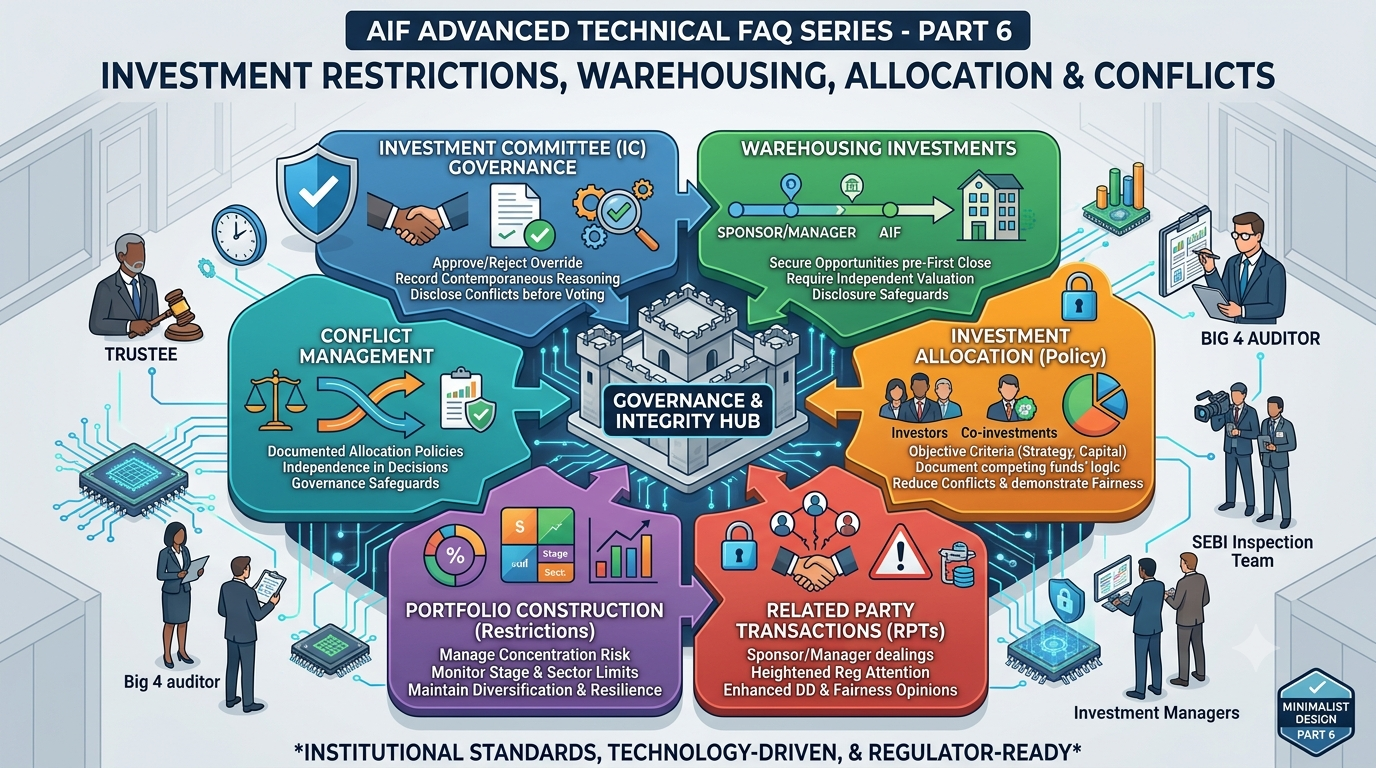
Investment Committee (IC)
Can the Investment Committee override the recommendation of the investment team?
Yes. The Investment Committee (IC) is generally the ultimate decision-making authority for approving or rejecting investment proposals, unless the governing documents provide otherwise. The IC is expected to independently evaluate commercial rationale, valuation assumptions, legal risks, sector concentration, ESG considerations and alignment with the investment strategy before approving a transaction.
Should every Investment Committee decision be supported by written reasoning?
Absolutely. Every investment approval or rejection should be supported by a contemporaneous Investment Committee Memorandum recording the commercial rationale, identified risks, valuation assumptions, dissenting opinions, voting outcome and conditions precedent. Proper documentation significantly strengthens regulatory defensibility.
Can an Investment Committee approve an investment subject to conditions?
Yes. Conditional approvals are common. The IC may require completion of legal due diligence, tax structuring, environmental reports, execution of shareholder agreements, valuation confirmations or regulatory approvals before permitting capital deployment.
Should Investment Committee members disclose conflicts before voting?
Yes. Any member having a direct or indirect financial, personal or professional interest in the proposed transaction should disclose the conflict before deliberations commence. Appropriate governance measures should then be adopted to preserve the independence of the decision-making process.
Should Investment Committee meetings maintain attendance registers?
Yes. Attendance records, voting registers, agenda papers, meeting minutes and supporting documents collectively establish an audit trail demonstrating that investment decisions were taken through a structured governance framework.
Warehousing Investments
What is warehousing in the context of an Alternative Investment Fund?
Warehousing refers to the acquisition of an investment by the Sponsor, Investment Manager or another designated entity before the fund's first closing, with the intention of subsequently transferring that investment to the Alternative Investment Fund after it becomes operational.
Why are warehousing arrangements used?
Warehousing enables commercially attractive opportunities to be secured before fundraising is completed, preventing the loss of time-sensitive transactions while allowing the fund to acquire the investment after achieving financial close.
What risks arise from warehousing transactions?
Warehousing transactions may give rise to valuation concerns, conflicts of interest, pricing disputes, disclosure issues, related party considerations and questions regarding fairness to incoming investors. Accordingly, they require enhanced governance and transparency.
Should warehoused assets be independently valued before transfer?
Yes. Independent valuation strengthens transparency by demonstrating that the transfer price reflects fair market value rather than benefiting either the Sponsor or the incoming fund.
Should warehousing arrangements be disclosed to investors?
Yes. Material warehousing arrangements should ordinarily be disclosed through the fund documentation so that investors understand the commercial rationale, pricing methodology, associated risks and governance safeguards.
Investment Allocation
Why should Investment Managers maintain a written investment allocation policy?
A documented allocation policy ensures that investment opportunities are allocated consistently across multiple funds, co-investment vehicles and managed accounts. It also reduces conflicts of interest and demonstrates fairness during regulatory inspections.
How should competing funds allocate the same investment opportunity?
Allocation should be determined using objective criteria such as investment strategy, available capital, sector focus, investment restrictions, portfolio diversification, investor mandates and commercial suitability rather than discretionary preferences.
Can the same Investment Manager manage competing funds?
Yes. However, the Investment Manager should maintain documented allocation policies, conflict management procedures and governance mechanisms to ensure equitable treatment of each fund.
Why should rejected investment opportunities also be documented?
Documenting rejected investments demonstrates that opportunities were evaluated objectively and provides evidence of prudent decision-making during audits, investor reviews and regulatory inspections.
Should investment allocation decisions be periodically reviewed?
Yes. Periodic reviews help identify allocation biases, improve governance standards and ensure that allocation policies continue to operate consistently across multiple investment vehicles.
Related Party Transactions
What constitutes a related party transaction for an Alternative Investment Fund?
A related party transaction generally involves dealings between the fund and its Sponsor, Investment Manager, affiliates, key managerial personnel or other connected entities where conflicts of interest may reasonably arise.
Why do related party transactions receive heightened regulatory attention?
Related party transactions present an inherent risk that commercial decisions may favour affiliated entities rather than investors. Consequently, regulators expect enhanced governance, transparency and documentation.
Should related party transactions undergo enhanced due diligence?
Yes. Independent commercial evaluation, legal review, valuation analysis and conflict assessments should ordinarily be undertaken before approving related party transactions.
Can independent experts strengthen related party governance?
Absolutely. Obtaining independent valuation reports, fairness opinions or external legal advice enhances credibility and demonstrates that decisions were taken objectively.
Should related party transactions be separately reported internally?
Yes. Maintaining a dedicated related party transaction register facilitates board oversight, internal audits and regulatory inspections.
Portfolio Construction
Why should Investment Managers establish portfolio construction guidelines?
Portfolio construction guidelines help manage concentration risk, liquidity exposure, sector allocation, geographical diversification, investment stage allocation and overall portfolio resilience.
Can excessive diversification negatively affect portfolio performance?
Yes. While diversification reduces concentration risk, excessive diversification may dilute management attention, increase monitoring costs and reduce the overall impact of high-performing investments.
Why is correlation analysis useful in portfolio construction?
Correlation analysis enables Investment Managers to evaluate how investments behave relative to one another, thereby improving diversification and reducing systemic portfolio risk.
Should portfolio concentration be monitored continuously?
Yes. Concentration metrics should be reviewed throughout the investment lifecycle rather than only at the time of acquisition, particularly after follow-on investments, valuation changes or exits.
Why should Investment Managers periodically rebalance portfolio risk?
Market conditions, portfolio valuations, sector developments and macroeconomic events evolve continuously. Periodic risk assessments ensure that the portfolio remains aligned with the fund's stated investment objectives.
Need Expert Assistance with Alternative Investment Funds?
Whether you are designing Investment Committee governance, warehousing transactions, investment allocation policies, conflict management frameworks, related party governance, portfolio construction methodologies, PPM documentation or institutional compliance systems, Anuj Desai & Associates advises Sponsors, Investment Managers, Trustees, Family Offices, Venture Capital Funds, Private Equity Funds, Infrastructure Funds and institutional investors on building regulator-ready Alternative Investment Funds. Our services include PPM drafting and review, PPM Audit, fund governance, Investment Committee frameworks, SEBI compliance, fund accounting, valuation governance, internal controls, regulatory inspections and ongoing advisory. Speak with Anuj Desai & Associates to build an Alternative Investment Fund that meets institutional standards, withstands regulatory scrutiny and inspires investor confidence.
Disclaimer
This article is intended solely for educational and informational purposes and should not be interpreted as legal, regulatory, tax, accounting or investment advice. Certain governance practices discussed above represent institutional best practices in addition to mandatory legal requirements. The SEBI (Alternative Investment Funds) Regulations, applicable circulars, master circulars, judicial precedents and contractual documentation should always be reviewed in the context of the specific facts of each fund. Readers are advised to seek professional advice before acting on any information contained herein.