
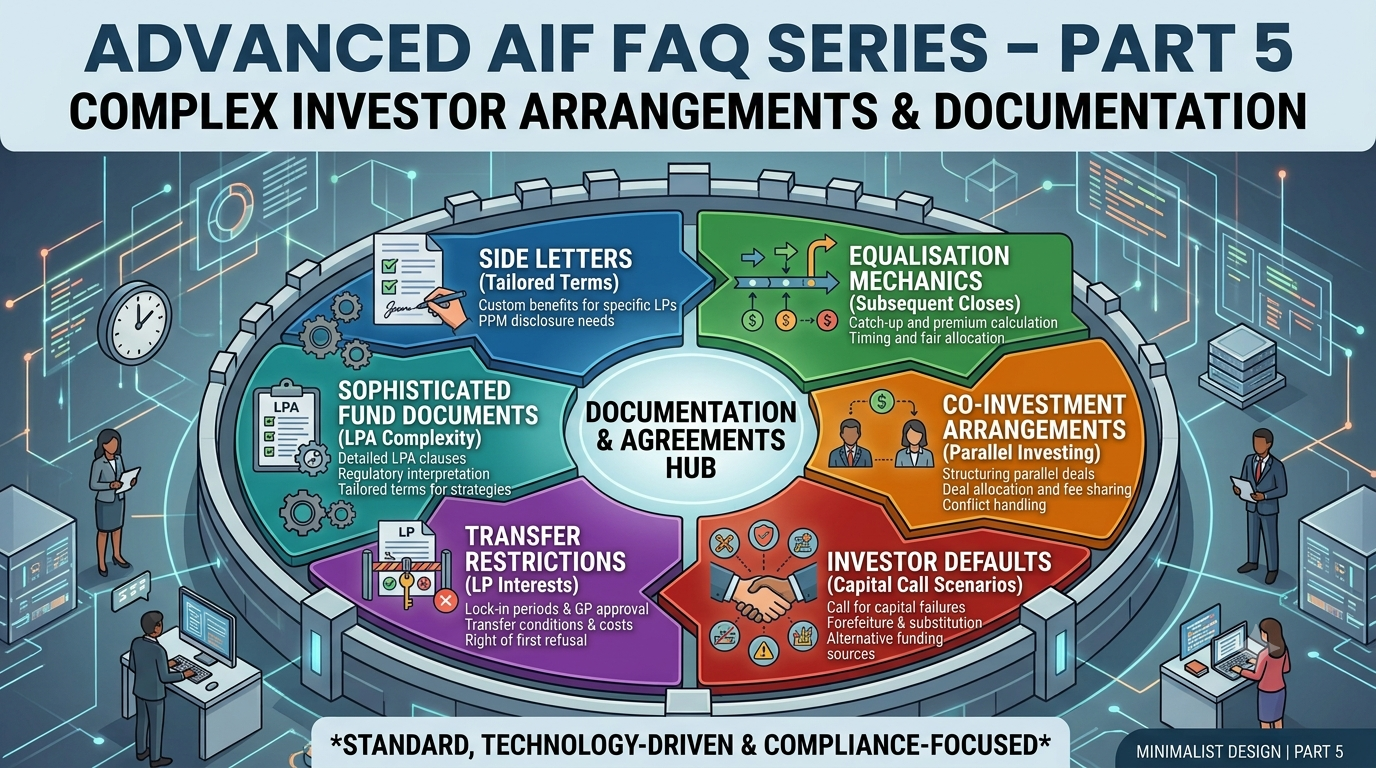
Side Letters
What is a Side Letter in an Alternative Investment Fund?
A Side Letter is a legally binding agreement executed between an Alternative Investment Fund (or its Investment Manager) and one or more specific investors, granting additional rights, clarifications or commercial arrangements that supplement—but generally do not replace—the terms of the Private Placement Memorandum (PPM) and contribution agreement. Side Letters are commonly negotiated by institutional investors, sovereign wealth funds, pension funds and large family offices.
Are Side Letters legally enforceable in India?
Yes. Provided they are validly executed, supported by consideration where required, consistent with applicable law and not contrary to the governing documents of the fund or SEBI Regulations, Side Letters are generally enforceable contractual arrangements.
Can every investor demand a Side Letter?
No. A Side Letter is typically negotiated based on the commercial bargaining power of the investor, regulatory requirements applicable to that investor or operational requirements that cannot be uniformly extended to all investors.
Can a Side Letter override the Private Placement Memorandum?
Generally, no. A Side Letter should not override mandatory provisions of the SEBI AIF Regulations or fundamentally alter the commercial structure disclosed to investors. It usually supplements specific contractual rights applicable only to the concerned investor.
What issues are commonly addressed through Side Letters?
Typical Side Letter provisions relate to enhanced reporting, ESG commitments, confidentiality obligations, most-favoured nation (MFN) rights, excuse rights, tax reporting, regulatory disclosures, information rights, fee arrangements and operational requirements applicable to particular investors.
Equalisation
What is Equalisation in an Alternative Investment Fund?
Equalisation is the process through which investors admitted during a subsequent closing contribute an additional amount to ensure that they are placed economically on the same footing as investors admitted during earlier closings.
Why is Equalisation required?
Without equalisation, investors joining the fund at a later stage could unfairly benefit from investments already made using capital contributed by earlier investors. Equalisation preserves fairness among all investors.
Is Equalisation the same as a Catch-up Contribution?
No. Although closely related, equalisation generally refers to the overall economic adjustment made for late-admitted investors, whereas a catch-up contribution represents the capital amount required to align their investment position with existing investors.
Can Equalisation include interest?
Yes. Many fund documents require subsequent investors to pay an equalisation amount together with an equalisation interest component intended to compensate earlier investors for the time value of money.
Should the Equalisation methodology be clearly documented?
Absolutely. The PPM should clearly specify the basis of equalisation, interest computation methodology, calculation period, allocation mechanism and accounting treatment to minimise disputes.
Co-Investments
What is a Co-Investment in an Alternative Investment Fund?
A co-investment refers to an investment opportunity where one or more investors participate directly alongside the Alternative Investment Fund in a portfolio company instead of investing solely through the pooled vehicle.
Why do Investment Managers offer Co-Investment opportunities?
Co-investments enable investors to increase exposure to attractive transactions, reduce blended management fee costs, strengthen investor relationships and facilitate execution of larger investment opportunities.
Do investors have an automatic right to participate in Co-Investments?
No. Unless specifically provided in the governing documents or a Side Letter, investors generally do not possess an automatic contractual right to receive co-investment opportunities.
How should Co-Investment opportunities be allocated?
Investment Managers should establish transparent allocation policies that are objective, equitable, documented and consistently applied to avoid conflicts of interest and investor disputes.
Can Co-Investments create conflicts of interest?
Yes. Improper allocation of co-investment opportunities may result in conflicts between the fund, its investors, affiliates and the Investment Manager. Clear governance policies are therefore essential.
Defaulting Investors
What constitutes an investor default in an Alternative Investment Fund?
An investor generally defaults when it fails to fulfil contractual obligations under the contribution agreement, including failure to honour capital calls, provide required documentation or comply with other material contractual commitments.
Can defaulting investors lose voting rights?
Yes. Many Alternative Investment Funds provide that investors who default on their obligations may temporarily lose voting rights until the default is cured, subject to the governing documents.
Can distributions be withheld from a defaulting investor?
Yes. Fund documents frequently permit the Investment Manager to withhold distributions otherwise payable to defaulting investors until outstanding obligations have been discharged.
Can a defaulting investor be compulsorily removed from the fund?
Subject to the governing documents, an Investment Manager may possess contractual rights to compulsorily transfer, redeem or otherwise deal with the units of a defaulting investor in accordance with the default provisions.
Why should default provisions be carefully drafted?
Clearly drafted default provisions reduce legal uncertainty, strengthen enforceability and provide practical remedies that protect both the fund and non-defaulting investors.
Fund Documentation
Why is consistency between the PPM, Contribution Agreement and Trust Deed important?
Inconsistencies among governing documents may create uncertainty regarding investor rights, fund operations, governance mechanisms and commercial arrangements. All constitutive documents should therefore be reviewed together before fundraising commences.
Should amendments to fund documents be centrally tracked?
Yes. Maintaining an amendment register ensures that all stakeholders work from the latest approved version of each governing document while facilitating regulatory inspections and legal reviews.
Why should defined terms remain consistent across fund documentation?
Uniform terminology reduces ambiguity, improves contractual interpretation and minimises disputes arising from inconsistent drafting across multiple legal documents.
Can commercially negotiated provisions be incorporated only through investor emails?
No. Material commercial terms affecting investor rights should ordinarily be documented through properly executed legal agreements rather than informal correspondence to ensure enforceability and legal certainty.
Should Alternative Investment Funds periodically undertake legal documentation reviews?
Yes. Periodic legal reviews help ensure that fund documentation remains aligned with evolving SEBI Regulations, taxation laws, judicial developments, commercial practices and operational realities throughout the lifecycle of the fund.
Need Expert Assistance with Alternative Investment Funds?
Whether you require assistance with fund structuring, Side Letter negotiations, Private Placement Memorandum drafting and review, co-investment frameworks, investor admission mechanics, equalisation models, capital call documentation, PPM Audits, fund accounting, SEBI compliance or ongoing regulatory advisory, Anuj Desai & Associates provides comprehensive legal, regulatory, accounting and compliance support across the entire lifecycle of Alternative Investment Funds. Our professionals advise Sponsors, Investment Managers, Trustees, Venture Capital Funds, Private Equity Funds, Infrastructure Funds, Family Offices and institutional investors on designing commercially robust and regulatorily compliant fund structures. Connect with Anuj Desai & Associates to build an institutional-quality Alternative Investment Fund with documentation that withstands investor scrutiny and regulatory review.
Disclaimer
The information contained in this publication is intended solely for general informational and educational purposes and should not be construed as legal, regulatory, tax, accounting or investment advice. Alternative Investment Funds are governed by evolving statutory provisions, SEBI Regulations, circulars, master circulars, judicial precedents and contractual arrangements. Professional advice should be obtained before acting upon any information contained herein. While every effort has been made to ensure accuracy, Anuj Desai & Associates accepts no responsibility for any loss arising from reliance on this publication.