
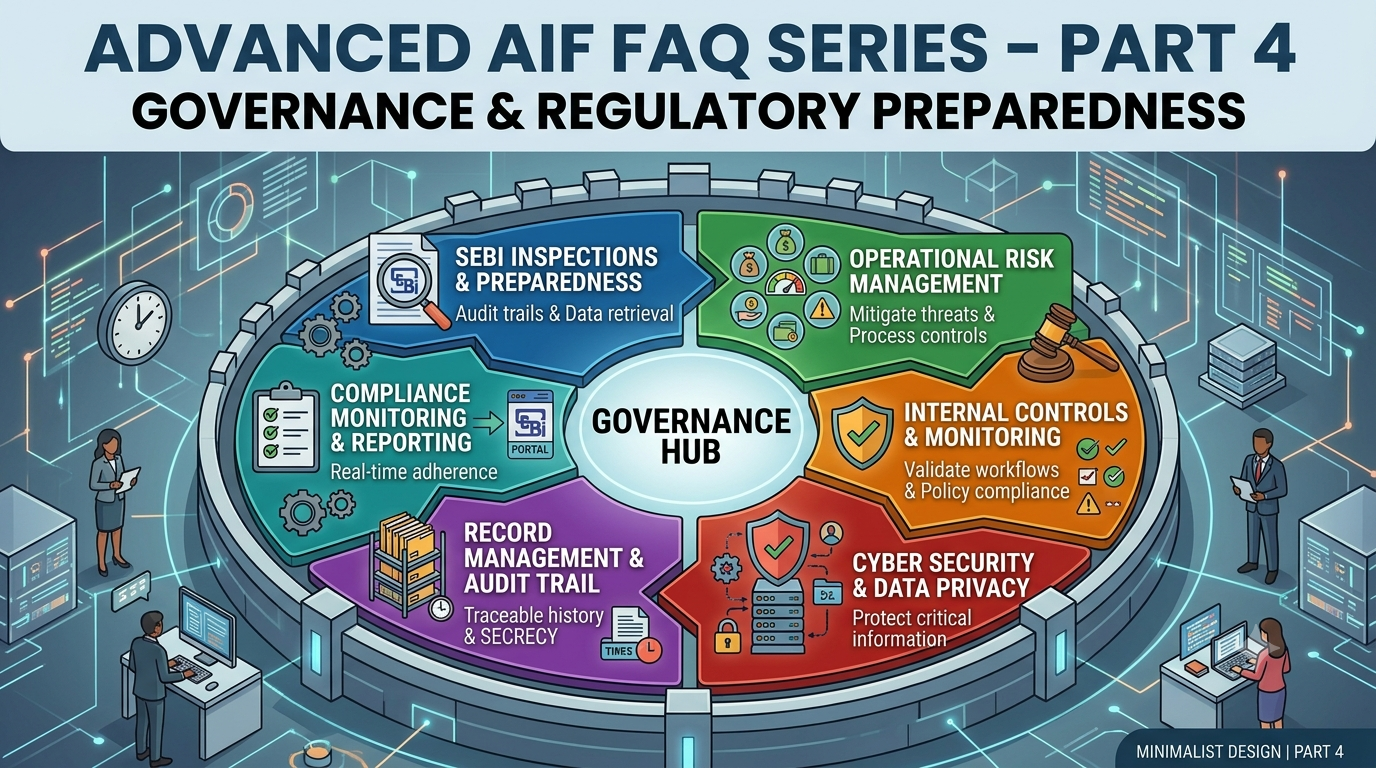
Regulatory Inspections
What are the primary objectives of a SEBI inspection of an Alternative Investment Fund?
SEBI inspections are conducted to evaluate whether an Alternative Investment Fund is operating in accordance with the AIF Regulations, its Private Placement Memorandum (PPM), internal governance framework and applicable circulars. Inspections generally focus on investor protection, regulatory compliance, operational transparency and record maintenance.
How should an Alternative Investment Fund prepare for a regulatory inspection?
Preparation should include maintaining updated statutory records, organised documentation, reconciled financial statements, valuation records, investor communications, compliance registers, board minutes, internal policies and supporting evidence for all material transactions.
What documents are commonly reviewed during a SEBI inspection?
Regulators may examine constitutional documents, the PPM, contribution agreements, investment approvals, valuation reports, investor registers, compliance reports, financial statements, audit reports, board minutes, internal policies, bank records and correspondence relating to regulatory filings.
Why should an Alternative Investment Fund conduct internal inspection readiness reviews?
Periodic readiness assessments help identify documentation gaps, compliance deficiencies and operational weaknesses before a regulatory inspection takes place, thereby reducing regulatory risk and improving governance standards.
Should inspection observations be documented and tracked?
Yes. Every inspection observation should be documented, assigned to responsible personnel, tracked through a remediation process and periodically reviewed by senior management until the identified issues have been fully resolved.
Risk Management
What is an enterprise risk management framework for an Alternative Investment Fund?
An enterprise risk management framework is a structured approach for identifying, assessing, monitoring and mitigating risks that may affect the fund's investments, operations, regulatory compliance, reputation or financial stability.
What types of risks should every Alternative Investment Fund monitor?
AIFs should continuously monitor investment risk, liquidity risk, valuation risk, operational risk, legal risk, compliance risk, cyber risk, fraud risk, counterparty risk, concentration risk, reputational risk and business continuity risks.
Why is concentration risk important in portfolio management?
Excessive concentration in a single investment, industry or geography may significantly increase portfolio volatility. Diversification and periodic portfolio reviews help manage concentration risk effectively.
How often should a fund's risk management framework be reviewed?
Risk management frameworks should be reviewed periodically and updated whenever there are significant regulatory changes, operational developments, investment strategy modifications or emerging market risks.
Should Investment Managers maintain formal risk registers?
Yes. Risk registers help document identified risks, assess their potential impact, record mitigation measures and facilitate periodic review by management and governance committees.
Internal Controls
Why are maker-checker controls important in Alternative Investment Funds?
Maker-checker controls reduce operational errors by ensuring that significant transactions are independently reviewed and authorised before execution. This segregation of duties strengthens governance and minimises fraud risk.
Should every Alternative Investment Fund implement approval matrices?
Yes. Clearly defined approval matrices establish accountability by specifying the individuals authorised to approve investments, expenses, investor admissions, distributions, banking transactions and regulatory filings.
Why should access to financial systems be restricted?
Restricting system access protects confidential information, reduces the risk of unauthorised transactions and strengthens cybersecurity by ensuring that users have access only to information relevant to their responsibilities.
How should changes to fund policies be managed?
Policy changes should be documented, formally approved, communicated to relevant stakeholders and incorporated into operational procedures to ensure consistent implementation across the organisation.
Why is segregation of duties critical in Alternative Investment Fund operations?
Separating responsibilities among different individuals reduces the likelihood of fraud, improves operational integrity, enhances accountability and strengthens internal control systems.
Operational Excellence
Why should Alternative Investment Funds maintain standard operating procedures (SOPs)?
Documented SOPs establish consistent operational processes, improve employee training, minimise errors, facilitate regulatory compliance and support business continuity during personnel changes.
How can automation improve Alternative Investment Fund operations?
Automation streamlines fund accounting, investor onboarding, workflow approvals, compliance monitoring, document management and regulatory reporting while reducing manual intervention and operational risk.
Why should key operational processes be periodically tested?
Regular testing helps verify that internal controls operate effectively, identifies process weaknesses and enables timely corrective action before operational failures occur.
What is operational resilience in an Alternative Investment Fund?
Operational resilience refers to the fund's ability to continue critical business functions despite disruptions such as technology failures, cyber incidents, natural disasters or other unforeseen events.
Why should Alternative Investment Funds periodically review service providers?
Periodic reviews help ensure that outsourced service providers continue to meet performance expectations, regulatory requirements, cybersecurity standards and contractual obligations.
Information Security & Cyber Governance
Why should Alternative Investment Funds adopt cybersecurity policies?
Cybersecurity policies establish controls for protecting confidential investor information, financial records and operational systems from cyber threats, unauthorised access and data breaches.
Should confidential investor information be encrypted?
Yes. Encryption provides an additional layer of security by protecting sensitive information during storage and transmission, thereby reducing the risk of unauthorised disclosure.
Why is cybersecurity awareness training important for employees?
Employees remain one of the primary targets of cyberattacks. Regular awareness training helps identify phishing attempts, social engineering risks and other cybersecurity threats before they compromise sensitive information.
Should Alternative Investment Funds maintain incident response procedures?
Yes. Incident response procedures enable organisations to identify, investigate, contain and recover from cybersecurity incidents efficiently while minimising operational disruption and regulatory exposure.
How often should business continuity and disaster recovery plans be tested?
Business continuity and disaster recovery plans should be tested periodically to ensure that critical systems, personnel and operational processes can be restored effectively during emergencies.
Need Expert Assistance with Alternative Investment Funds?
Whether you require assistance with SEBI inspections, governance reviews, compliance monitoring, internal control assessments, operational risk management, cybersecurity frameworks, fund accounting, valuation, investor reporting, PPM Audits or end-to-end regulatory compliance, Anuj Desai & Associates provides specialised advisory services tailored to Alternative Investment Funds across India. Our professionals work closely with Sponsors, Investment Managers, Trustees, Fund Administrators, Family Offices, Venture Capital Funds, Private Equity Funds, Infrastructure Funds and institutional investors to build robust governance frameworks, strengthen compliance systems and enhance operational excellence.
Partner with Anuj Desai & Associates to establish a resilient, compliant and institutionally governed Alternative Investment Fund.
Disclaimer
The information contained in this publication is intended solely for general informational and educational purposes and should not be construed as legal, regulatory, tax, accounting or investment advice. The regulatory framework governing Alternative Investment Funds is continuously evolving through amendments, SEBI regulations, circulars, master circulars, notifications and judicial developments. Readers should obtain independent professional advice based on their specific facts and circumstances before acting upon any information contained herein. While every effort has been made to ensure accuracy, Anuj Desai & Associates does not accept any responsibility or liability for any loss arising from reliance on this publication.