
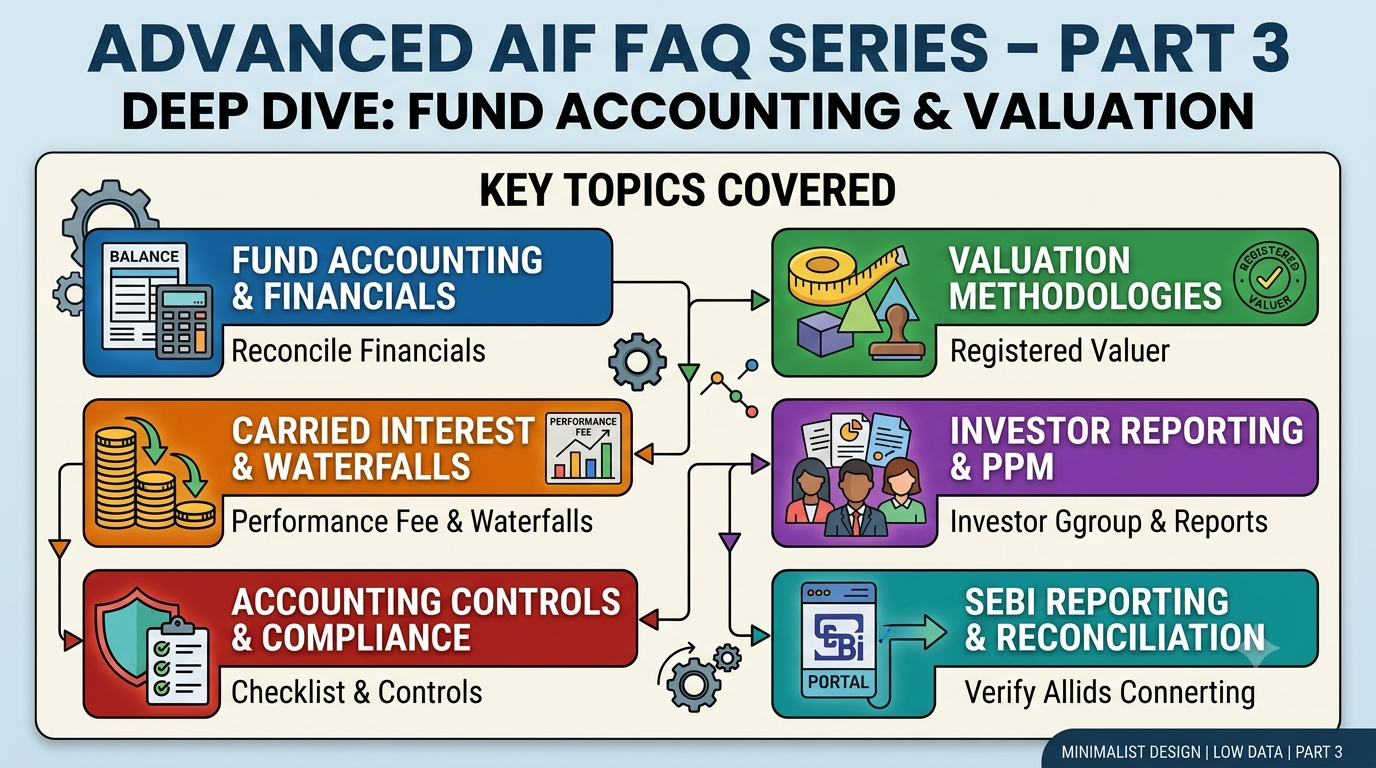
Fund Accounting
What is fund accounting in an Alternative Investment Fund?
Fund accounting is a specialised accounting system used to record capital commitments, capital calls, investments, realised gains, unrealised gains, expenses, distributions, management fees, carried interest and investor-wise capital balances. Unlike traditional corporate accounting, fund accounting focuses on accurately allocating financial activity among investors while ensuring transparency and regulatory compliance.
Why is fund accounting different from normal company accounting?
Unlike companies that focus on shareholder profits, Alternative Investment Funds maintain individual capital accounts for each investor. Every contribution, distribution, allocation of income, expense and investment performance must be accurately reflected investor-wise, making fund accounting significantly more specialised.
Should every Alternative Investment Fund maintain investor-wise capital accounts?
Yes. Investor-wise capital accounts are fundamental to the administration of an Alternative Investment Fund. These accounts record each investor's commitments, drawdowns, ownership percentage, distributions, allocated income and remaining capital balance throughout the life of the fund.
What accounting records should every Alternative Investment Fund maintain?
Every AIF should maintain complete books of account including journals, ledgers, bank books, investment registers, capital account schedules, expense registers, valuation records, distribution statements, management fee workings, carried interest calculations, financial statements and supporting documentation.
Why should fund accounting be performed on a timely basis?
Timely accounting enables accurate investor reporting, proper NAV computation, regulatory compliance, tax reporting, financial statement preparation and informed investment decisions by the Investment Manager.
Valuation
Why is valuation one of the most important functions of an Alternative Investment Fund?
Valuation directly impacts investor confidence, performance measurement, carried interest calculations, management fees, financial reporting and regulatory disclosures. Inaccurate valuations may expose the fund to investor disputes and regulatory scrutiny.
What is fair value in the context of Alternative Investment Funds?
Fair value represents the estimated price that would be received upon selling an asset in an orderly transaction between knowledgeable market participants on the valuation date under prevailing market conditions.
Why should valuation methodologies remain consistent?
Consistent valuation methodologies improve comparability across reporting periods, reduce subjectivity, enhance investor confidence and strengthen compliance with accounting standards and regulatory expectations.
Should valuation assumptions be documented?
Yes. Every significant assumption used in determining the value of portfolio investments should be documented along with supporting evidence, valuation models, management judgments and professional opinions where applicable.
How frequently should valuation policies be reviewed?
Valuation policies should be reviewed periodically to ensure they remain consistent with accounting standards, regulatory guidance, market developments and the nature of investments held by the Alternative Investment Fund.
Management Fees
What is the purpose of charging a management fee?
Management fees compensate the Investment Manager for portfolio management, investor servicing, compliance management, research, transaction execution, reporting and administration throughout the lifecycle of the fund.
Can management fees vary during the life of the fund?
Yes. Depending upon the governing documents, management fees may change after the investment period, reduce upon achieving specified milestones or be calculated using different methodologies during different phases of the fund.
Are management fees charged irrespective of investment performance?
Generally, yes. Management fees compensate the Investment Manager for managing the fund and are typically payable regardless of investment performance unless otherwise specified in the governing documents.
How should management fees be disclosed?
Management fees should be transparently disclosed in the Private Placement Memorandum together with the basis of computation, payment frequency, applicable taxes and any circumstances under which the fee structure may change.
Why should investors understand the management fee structure before investing?
Management fees directly affect investor returns over the life of the fund. Investors should understand the fee methodology, timing, calculation basis and interaction with carried interest before making investment decisions.
Carried Interest & Distributions
What is carried interest in an Alternative Investment Fund?
Carried interest represents the performance-based share of profits allocated to the Sponsor or Investment Manager after investors have received distributions in accordance with the agreed distribution waterfall.
Why is a distribution waterfall important?
The distribution waterfall determines the order in which investment proceeds are distributed among investors and the Investment Manager. A clearly drafted waterfall minimises disputes and improves transparency.
Can different classes of investors receive different distribution rights?
Yes. Where permitted under the governing documents and applicable law, different investor classes may have varying economic rights, distribution priorities or commercial arrangements.
Should carried interest calculations be independently verified?
Yes. Independent review of carried interest calculations reduces computational errors, improves investor confidence and supports accurate financial reporting.
Why should distribution calculations be thoroughly documented?
Detailed documentation provides transparency regarding allocation methodologies, protects the Investment Manager during audits and facilitates verification by investors and regulators.
Investor Reporting
What information is generally included in investor reports?
Investor reports commonly include portfolio summaries, capital account statements, investment performance, valuation updates, realised and unrealised gains, distributions, capital calls, financial highlights and regulatory disclosures.
Why are investor statements important?
Investor statements enable investors to monitor their investment performance, reconcile capital balances, understand distributions and assess the financial position of the Alternative Investment Fund.
Should investor reports be consistent across reporting periods?
Yes. Consistency enables meaningful comparison of financial performance, portfolio development and investor returns across multiple reporting periods.
Why should investor communications be documented?
Documented investor communications promote transparency, reduce misunderstandings, provide evidence during disputes and demonstrate sound governance practices.
Can technology improve investor reporting?
Modern investor reporting platforms provide secure online access to capital account statements, financial reports, tax documents, investment updates and regulatory communications, improving both operational efficiency and investor experience.
Need Expert Assistance with Alternative Investment Funds?
Whether you are launching a new Alternative Investment Fund, implementing fund accounting systems, preparing investor reporting frameworks, designing carried interest models, reviewing valuation methodologies, preparing financial statements, conducting PPM Audits or strengthening your compliance processes, Anuj Desai & Associates provides specialised advisory services across the complete lifecycle of Alternative Investment Funds. Our professionals assist Sponsors, Investment Managers, Trustees, Family Offices, Venture Capital Funds, Private Equity Funds, Infrastructure Funds and institutional investors with fund structuring, accounting, audit support, taxation, regulatory compliance and governance.
Contact Anuj Desai & Associates to build a transparent, compliant and institutionally managed Alternative Investment Fund.
Disclaimer
The contents of this article are intended solely for general informational and educational purposes and should not be construed as legal, regulatory, accounting, taxation or investment advice. The regulatory framework governing Alternative Investment Funds continues to evolve through amendments, SEBI circulars, master circulars and judicial developments. Professional advice should always be obtained before taking any decision based on the information contained herein. While every effort has been made to ensure the accuracy of this material, Anuj Desai & Associates accepts no liability for any loss arising from reliance on this publication.